3 million
Fraud reports received
FTC Consumer Sentinel Network, 2025. Reports are not a count of unique victims.
Read the FTC source →A CALMER RESPONSE TO A CONVINCING SCAM
Help your family verify the story before money or personal information changes hands.
A practical digital course, printable family tools, and realistic drills. Not another warning to forget. A plan to use together.

Illustrative image. No detection or monitoring software included.
THE SCALE IS REAL. YOUR NEXT STEP CAN BE SIMPLE.
A convincing request can put love, fear and money in the same conversation. Agree on a response together before you have to improvise one.
3 million
FTC Consumer Sentinel Network, 2025. Reports are not a count of unique victims.
Read the FTC source →$15.9 billion
Reported in the FTC's 2025 fraud data, across consumers. Not an estimate of an individual's risk.
Read the FTC source →$7.7 billion
Approximate losses in the FBI's 2025 IC3 release. A different reporting dataset.
Read the FBI source →Period: 2025. Sources checked September 17, 2026. These are reported incidents and losses, not a census of all victims. FTC and FBI figures use different systems and can overlap; do not add them. The course has not been shown to eliminate these losses and is not endorsed by these agencies. These are fixed historical figures, not live victim counters.
THE MOMENT THAT MATTERS
Learn to recognize the request underneath the story: money, a code, account access, or secrecy. Then step outside the caller's control.
A voice sounds like someone you love. The caller needs money now and asks you to keep it secret.
An unexpected caller claims to be your bank and directs a transfer to a supposedly protected account.
An official-sounding caller demands urgent payment, unusual payment methods, or continued secrecy.
A pop-up or unexpected support call asks for remote access, screen sharing, or a verification code.
A message about a delivery, toll, account, or payment steers you toward a link and an urgent login.
After a loss, another unsolicited contact promises recovery in exchange for an advance payment.
Examples are fictional, simplified learning scenarios. General verification guidance: FTC phone scams, family emergencies, and what to do after a scam.
ONE SHARED FAMILY ROUTINE
You don't need to identify every new scam. Practice a repeatable response to unexpected, high-pressure requests.
Recognition, caller ID, and personal details are not enough.
Leave the call, message, or page that created the pressure.
Use a saved number, physical card, or trusted official app.
Add a second perspective for high-risk requests.
Pause payments and access changes until facts match.
Make the decision outside the unexpected contact's control.
PRACTICAL, NOT JUST THEORETICAL
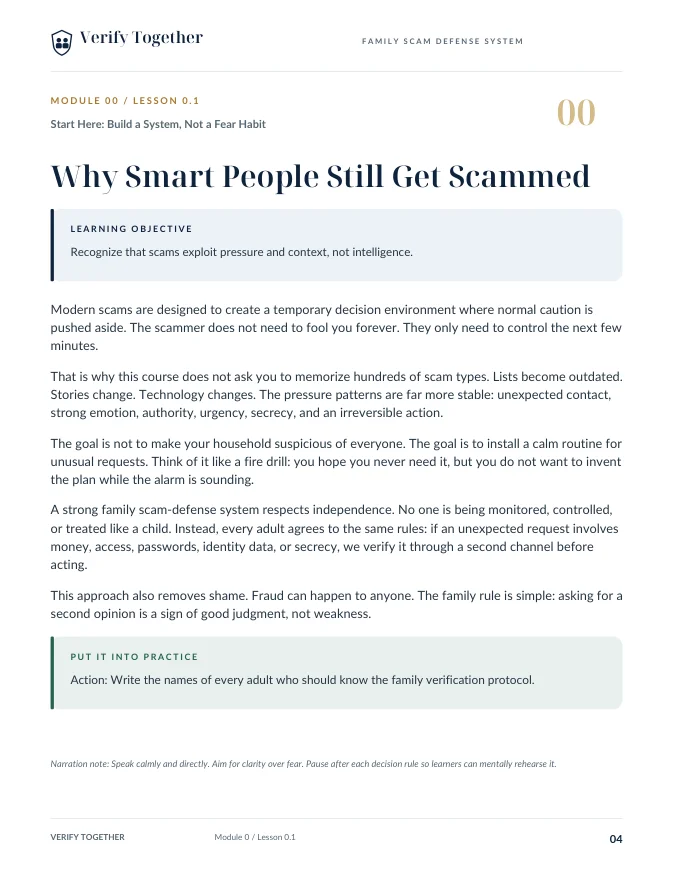
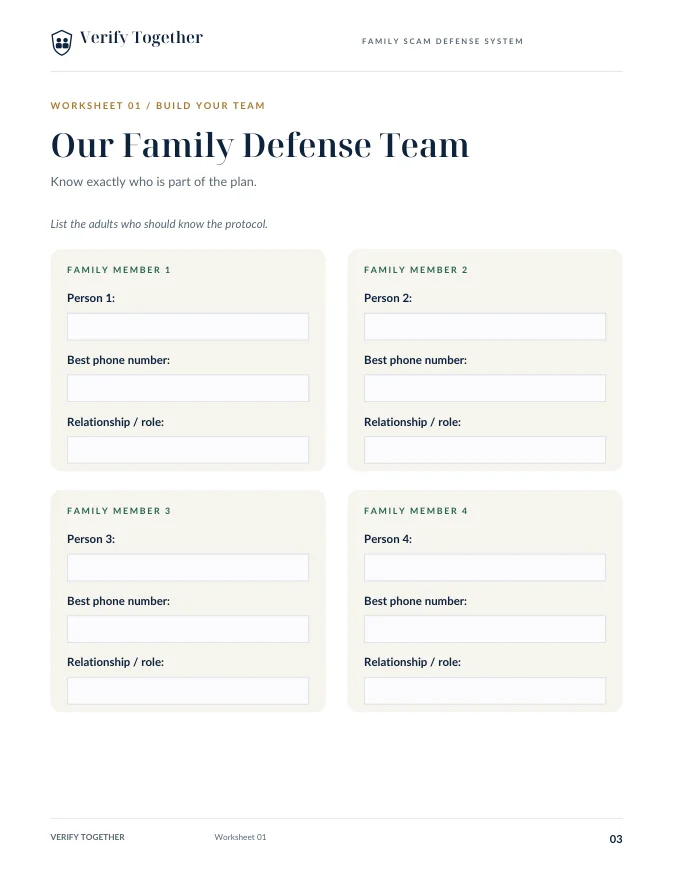
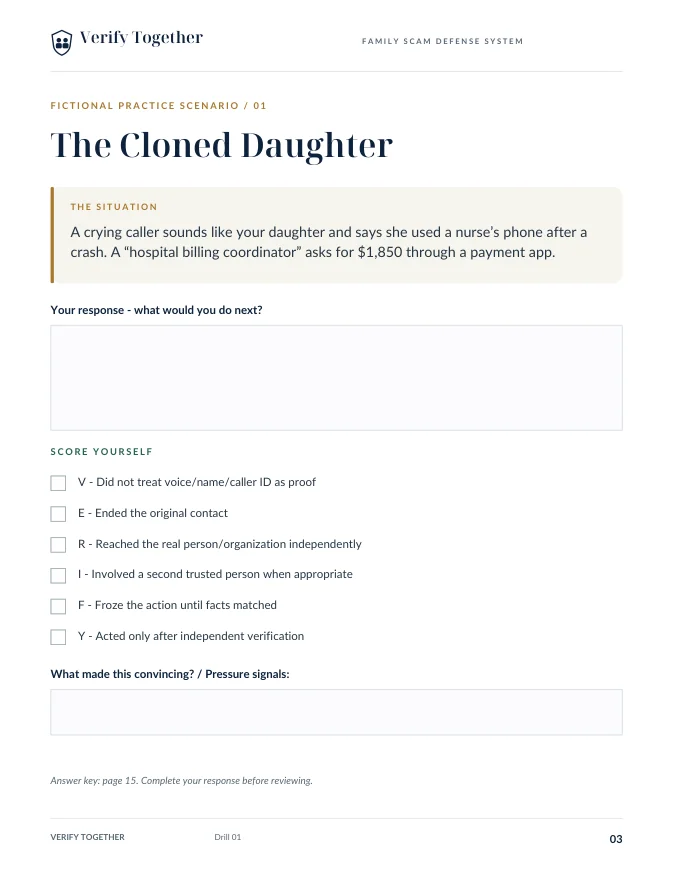
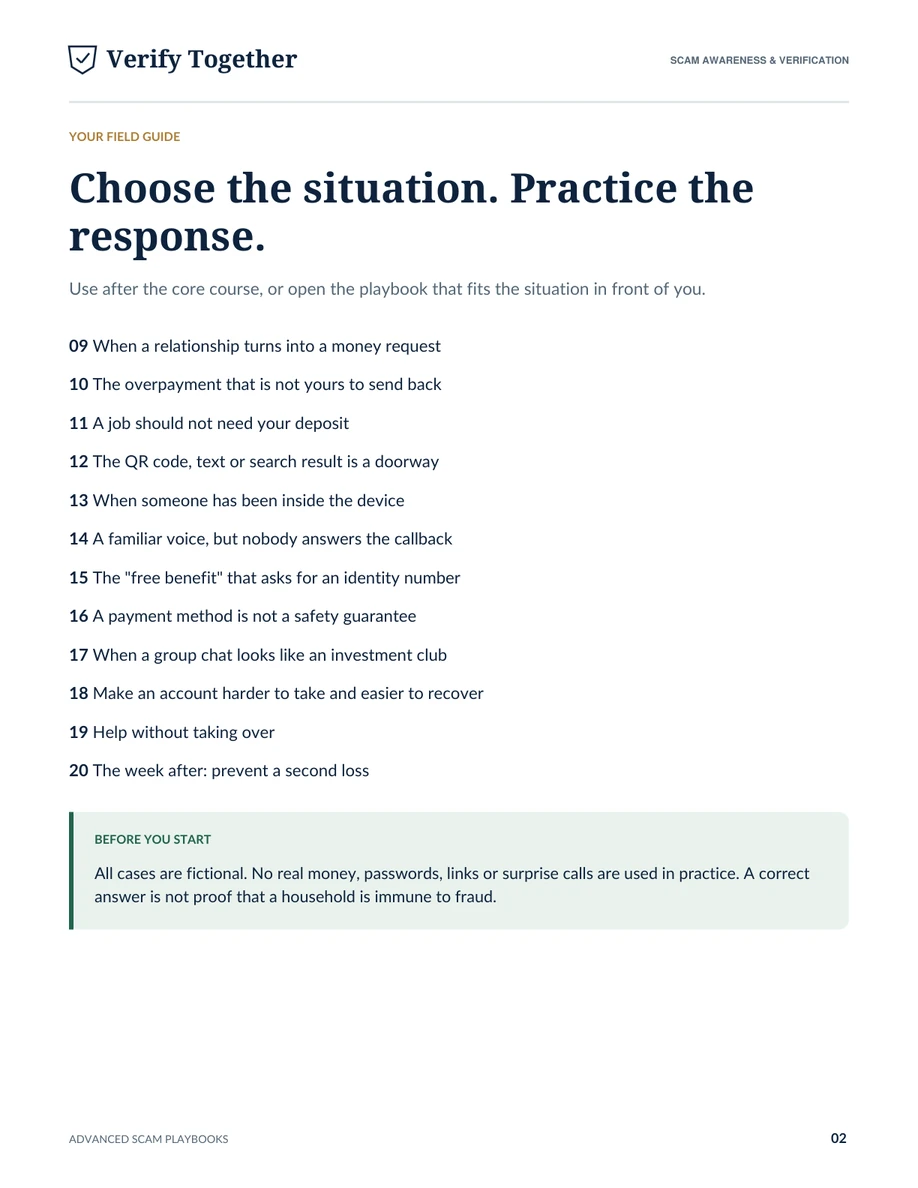
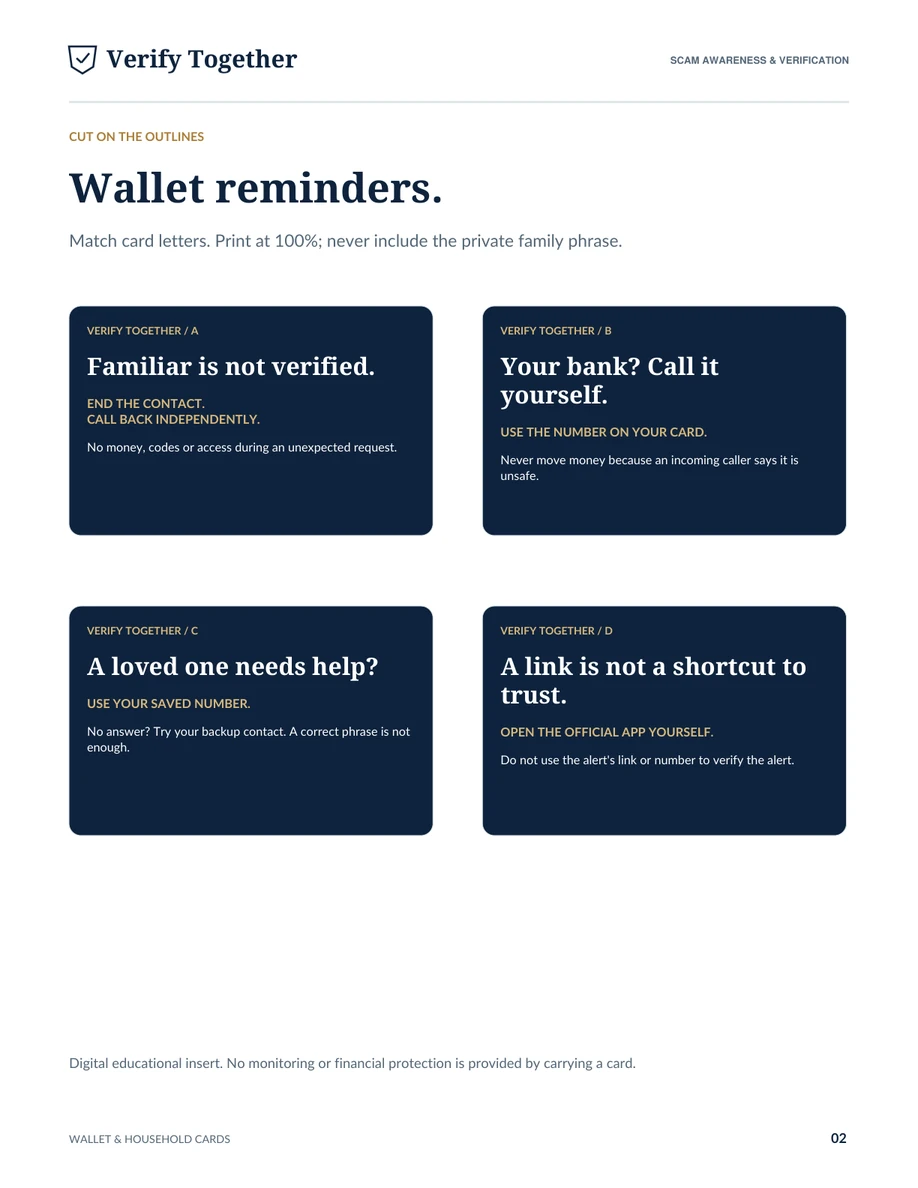
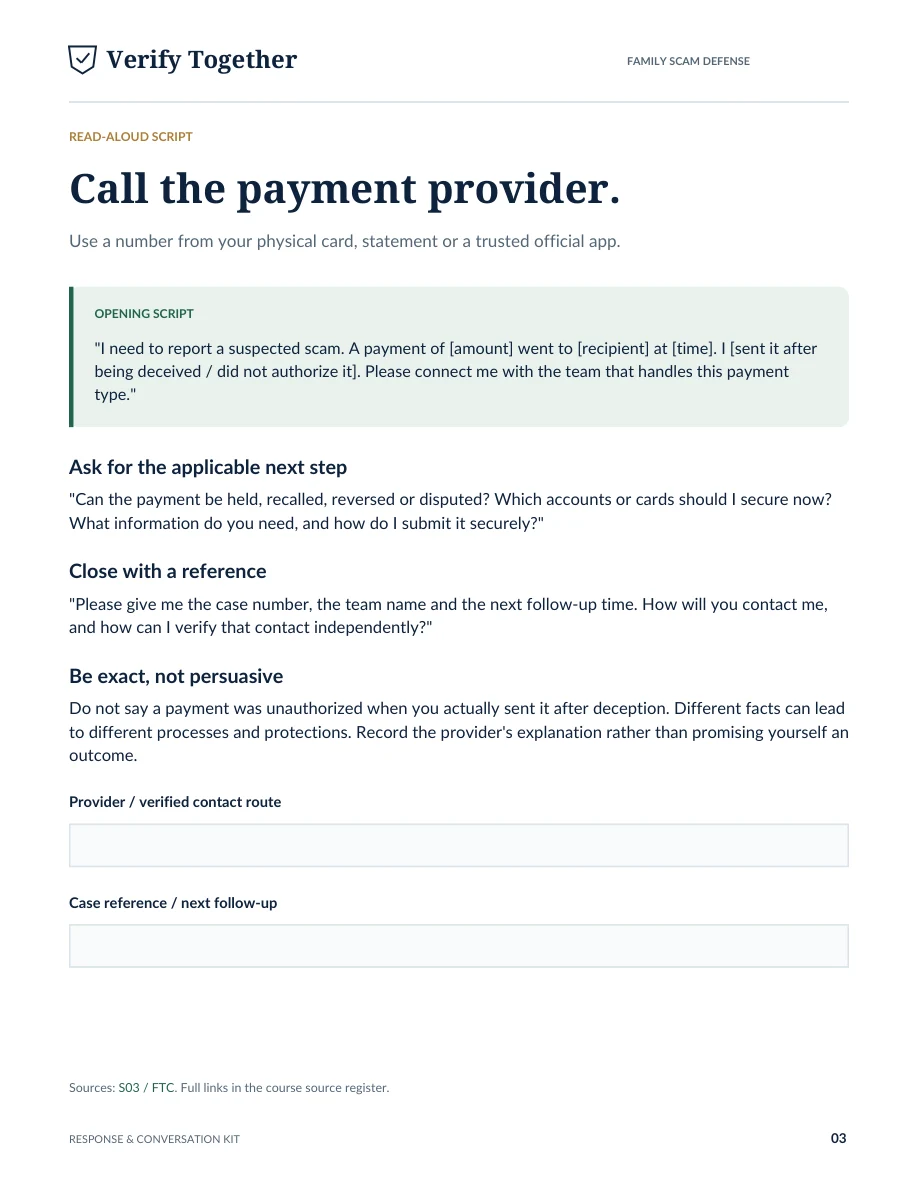
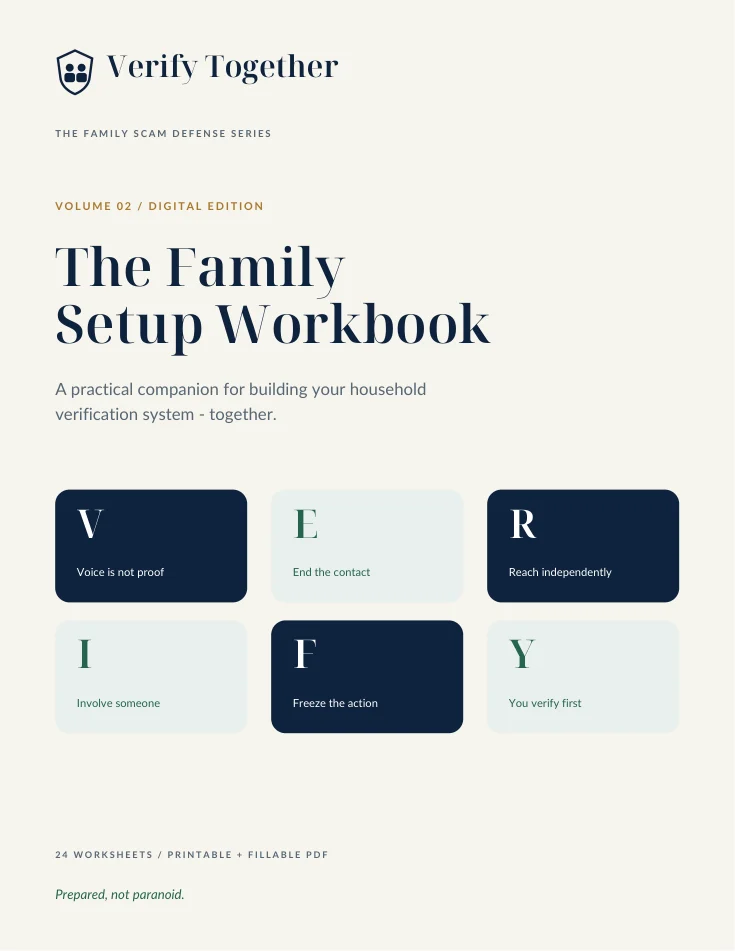
Actual pages from the included materials. Digital files for your household, not physical products or an ongoing monitoring service.

26 core lessons plus 12 advanced playbooks: relationships, fake jobs, overpayments, Medicare, account access and the hard cases.
Trusted contacts, payment-pause rules, account-safety checklists, and your household agreement. Print or fill in a compatible PDF reader.
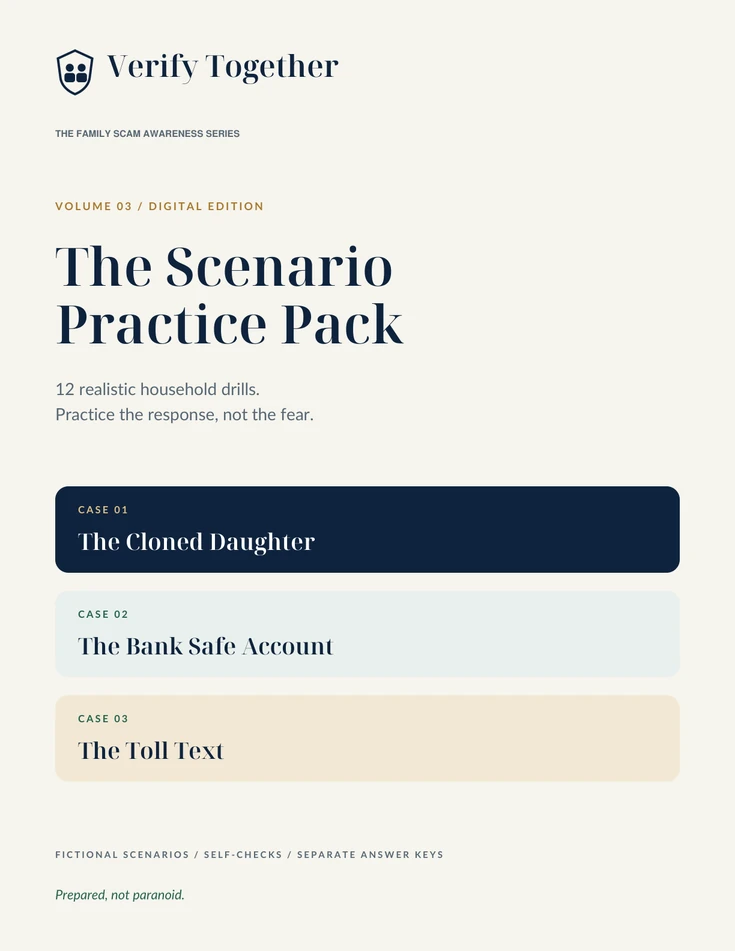
12 core scenarios plus 12 advanced cases, with separate explanations and an offline, interactive Practice Lab.
TRY THE APPROACH
No email needed. No information stored. Just one practice decision.
This is a learning exercise, not a test of intelligence or a measure of your personal risk.
FICTIONAL FAMILY-EMERGENCY SCENARIO
"Dad, I lost my phone. I need $900 right now. Don't call anyone else."
The voice sounds familiar. Choose the best next step.
YOUR LEARNING PATH
Read at your own pace. Set up the core household plan together, then return to the drills when you need practice.
Understand urgency, authority, secrecy, and the moment to stop an incoming request.
Build two-channel verification, a callback tree, and a family code phrase that never replaces independent checking.
Rehearse what to do when a voice sounds familiar but the request asks for money and secrecy.
Practice fake-bank, government, tech-support, delivery, toll, and subscription scenarios.
Review spam settings, one-time codes, account recovery, unexpected links, and QR codes.
Agree on a money pause, understand credit-freeze concepts, and preserve each adult's independence.
Find the payment provider, secure exposed accounts, preserve evidence, and use official reporting resources. Recovery is not guaranteed.
Use the household agreement, repeat a short drill, and revisit the plan when contacts or devices change.
Online relationships, marketplace overpayments, fake jobs, QR codes, remote access, missed callbacks, Medicare identity, transfer pressure, investment groups, account recovery, consent-based help and recovery scams.
SHARED BY COURSE PURCHASERS
Start with the actual course pages and a sample scenario. When purchasers choose to share their experience here, their words will appear with purchase verification.
Look inside the materials →A SMALLER DECISION TODAY
Start a respectful conversation. Agree on what happens before an urgent request becomes a rushed decision.
No blame. No monitoring another adult without consent. No taking away independence.
One-time digital purchase. Applicable taxes are shown at checkout. Paddle is the Merchant of Record for Paddle-processed orders.
Digital download only. No physical delivery, recorded video, monitoring software, or guaranteed protection.
One-time digital purchase. When Paddle checkout is live, Paddle is the Merchant of Record for Paddle-processed orders. Applicable taxes and the final total are shown at checkout.
Terms & Conditions Refund Policy Privacy Policy
Buyer support: support@familyreadyplan.com · +995595889866
CLEAR EXPECTATIONS
Useful education starts with knowing exactly what you are buying.
Both. It is designed for adults who want to agree on a household verification routine together. Every adult keeps control of their own choices.
No. This edition includes nine PDFs and an offline interactive Practice Lab. It combines a written course, advanced playbooks, a visual PDF deck, worksheets, cards, response scripts and scenario drills. No recorded video is included.
No. Verify Together does not analyze calls, detect AI voices, block payments, insure losses, or monitor accounts. It teaches a family response process.
Start with a suggested 20-minute setup, then read and practice at your own pace over the included 30-day plan. The complete course takes longer than a setup session. Time varies; you do not have to finish everything at once.
Yes. The workbook includes interactive text fields and checkboxes. Open the PDF in a compatible reader, fill it in, save a local copy, and reopen it to check your entries. You can also print it. Browser PDF support varies. Never enter passwords, full account numbers, or Social Security numbers.
No. No outcome or loss-prevention guarantee is offered. This is independent educational content, not personal legal, financial, cybersecurity, or recovery advice.
No. It contains 24 fictional multiple-choice cases and explanations. It opens locally in a modern browser, asks for no personal information and does not analyze real messages or calls. Progress is kept only on this browser if you choose to remember it.
After payment is confirmed and your order is granted download access, your store order details provide the digital files. Check the store's terms and refund policy before purchasing.
Do not wait to finish a course. Contact the relevant financial institution or payment provider immediately through a verified channel and use official reporting and recovery resources. For immediate physical danger in the U.S., contact emergency services.